Two national conferences celebrating the 70th anniversary of Vietnam National University of Agriculture
As Vietnam National University of Agriculture (VNUA) celebrates its 70th anniversary (1956-2026), the Research Group Microbiology and Food Safety, Faculty of Food Science and Technology, has made a notable academic contribution through its involvement in organizing two national conferences on food safety risk governance and management. More than scholarly forums, these events brought scientific knowledge into closer dialogue with regulatory authorities, businesses and food production practice.
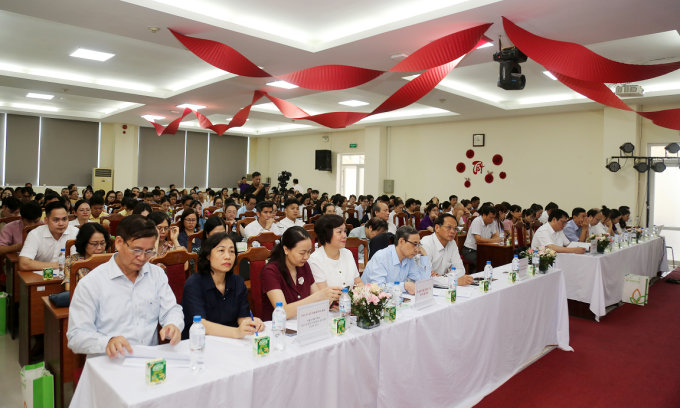
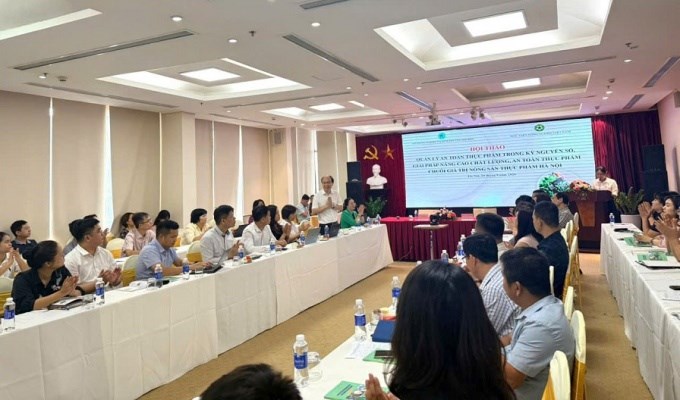
Two national conferences co-organized by the Faculty of Food Science and Technology in 2026 as meaningful contributions to the 70th anniversary of Vietnam National University of Agriculture.
From upstream risk governance to data driven food safety
On 27 May 2026, the conference titled “Digital Transformation in Food Safety Risk Governance: From Research to Production and Business Practice” was held at the National Institute for Food Control. The event was jointly organized by the Vietnam Food Safety Science and Technology Association, the National Institute for Food Control, the Faculty of Food Science and Technology (Vietnam National University of Agriculture), the School of Chemistry and Life Sciences (Hanoi University of Science and Technology), and partner organizations.
As a core academic team within the Faculty, the Research group Microbiology and Food safety helped connect three essential domains: policy, science and production practice. In her presentation, Assoc. Prof. Nguyen Thi Thanh Thuy addressed the control of agricultural inputs and emphasized a fundamental principle: food safety must be built in from the outset through control of soil, water, plant varieties and animal breeds, feed, agricultural inputs and production conditions, rather than relying solely on end-product inspection.
This message directly supports the shift required in food safety management today: from responding to incidents to preventing them; from managing individual stages to governing the entire supply chain; and from decisions based largely on experience to decisions informed by data, risk assessment and early warning. The conference also examined artificial intelligence, the Internet of Things, blockchain, traceability systems and advanced testing technologies as tools for earlier detection, more accurate risk localization and more effective control.
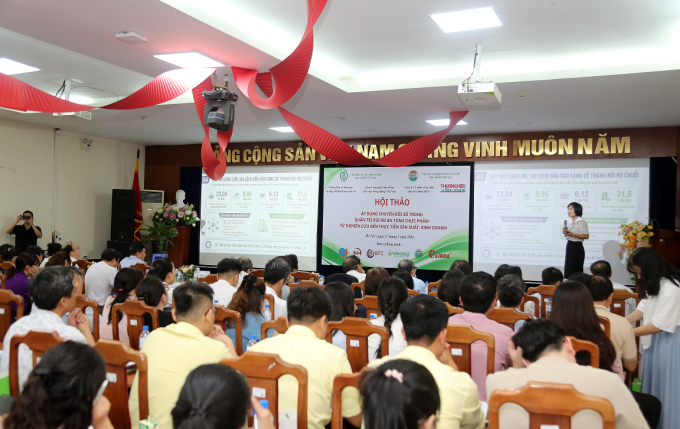
Assoc. Prof. Dr. Nguyen Thi Thanh Thuy presents an upstream approach to controlling food safety risks in agricultural production.
Practical recommendations for Hanoi through risk based management and connected data
On 20 August 2026, the Research Group Microbiology and Food Safety and the Hanoi Department of Agriculture and Environment jointly organized the conference “Food Safety Management in the Digital Era and Solutions to Improve the Quality and Safety of Hanoi’s Agri-food Chains.” The event carried the discussion from academic exchange into practical recommendations for a major urban market characterized by high consumption demand, extensive supply networks and strong interprovincial linkages.
At the conference, Dr. Phan Thi Phuong Thao of the Faculty of Food Science and Technology examined vulnerable points in Hanoi’s food supply chains and called for a shift from inspection and enforcement after violations occur to the early identification and prevention of risks. Her recommendations included developing risk maps by location and season; improving interprovincial data connectivity and sharing; modernizing supply chains and laboratory capacity; increasing data transparency; strengthening early-warning mechanisms; and improving risk-governance capacity among businesses.
These recommendations were firmly grounded in current practice. According to the Government News report, Hanoi’s traceability system already contained data for more than 12,300 products assigned QR codes by 3,300 establishments. The next challenge is therefore not simply to collect data, but to standardize, connect and use it effectively for forecasting, surveillance and evidence-based decision-making.
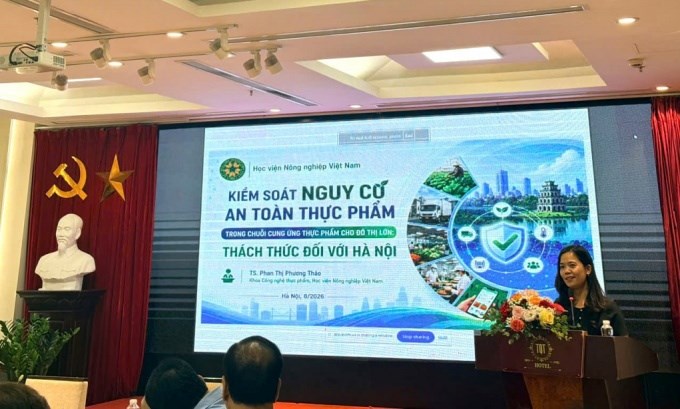
Dr. Phan Thi Phuong Thao proposes risk-based food safety management supported by risk mapping.
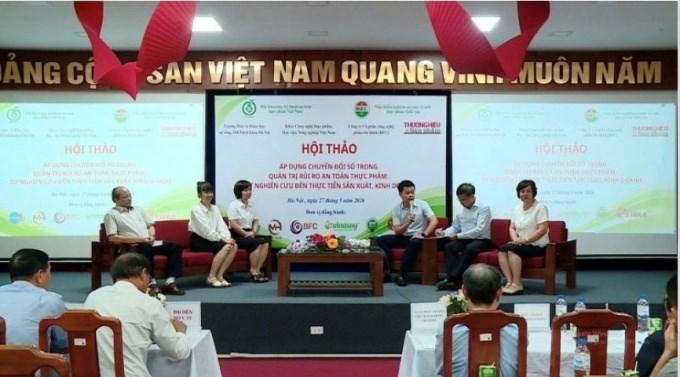
Panel discussion at the first conference
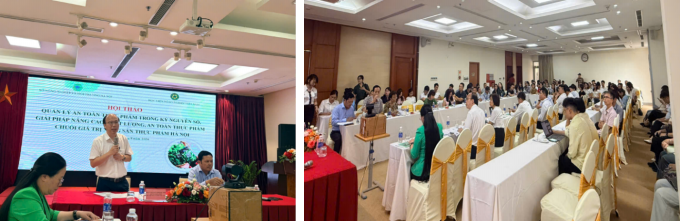
Panel discussion at the second conference
Academic contributions amplified by national media coverage
The significance of the two conferences was reflected not only in their academic content, but also in their public reach. The event held on 27 May was covered by the Vietnam Food Administration, Suc khoe & Doi song Newspaper and specialist media outlets, which highlighted the need for upstream risk governance and the role of digital technology. The conference held on 20 August was reported by Government News, the Hanoi Department of Agriculture and Environment, and VNUA’s communication channels, drawing attention to recommendations for safer food supply chains in the capital.
Coverage by established public and specialist media underscores the timeliness, academic substance and policy relevance of the forums co-organized by the Faculty and the Research Group. More importantly, it carried the conferences’ central scientific message beyond the meeting rooms: risks should be controlled at source, management should extend across the entire supply chain, and data create value only when translated into stronger prevention capacity.
A meaningful scientific contribution to VNUA’s 70th anniversary
Throughout its 70-year history, Vietnam National University of Agriculture has linked education and research with the major challenges facing agriculture, rural development and society. The two national conferences held in 2026 continued that tradition through concrete contributions: creating interdisciplinary forums, connecting regulatory authorities with scientists and businesses, advancing practical solutions, and reinforcing VNUA’s academic voice in food safety.
For the Research group Microbiology and Food safety, these events demonstrate strengths extending beyond specialized research on microorganisms and food-related hazards. They also reflect the group’s capacity to place scientific findings within the broader context of supply-chain governance, risk assessment and real-world needs. Building on the two conferences, the group will continue to pursue evidence-based research with clearly defined applications and the potential to inform practical management solutions.
The conferences addressed food safety at two complementary levels, yet shared one purpose: applying science where it can resolve real constraints, make food safer, improve supply-chain transparency and enable more proactive governance. This is a practical contribution by the Research group Microbiology and Food safety to the activities celebrating the 70th anniversary of Vietnam National University of Agriculture.
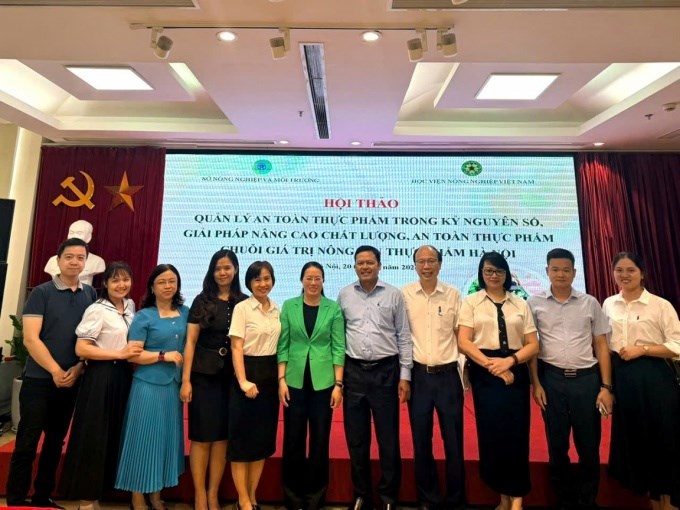
Commemorative group photograph
Sources:
Cục An toàn thực phẩm: “Chuyển đổi số để quản trị rủi ro an toàn thực phẩm từ gốc” (27/5/2026)
Báo Sức khỏe & Đời sống: “Chuyển đổi số để quản trị rủi ro an toàn thực phẩm từ gốc” (27/5/2026)
Tạp chí Thương hiệu và Sản phẩm: “Chuyển đổi số ‘từ gốc’ để kiểm soát rủi ro an toàn thực phẩm” (28/5/2026)
Báo Điện tử Chính phủ: “Đẩy mạnh quản lý, nâng cao chất lượng an toàn thực phẩm” (20/8/2026)
Cổng TTĐT Sở Nông nghiệp và Môi trường Hà Nội: “Đẩy mạnh quản lý, nâng cao chất lượng an toàn thực phẩm”
Hanoi Department of Agriculture and Environment: “Strengthening food safety management and quality”
Faculty of Food Science and Technology