From October 27 to 29, 2026, the Sustainable Life Sciences Network Workshop 2026 was held in Hanoi, jointly organized by Hanoi University of Science and Technology (HUST), the University of Natural Resources and Life Sciences, Vienna (BOKU), Austria, and Vietnam National University of Agriculture (VNUA). The workshop brought together scientists from BOKU (Austria); Kasetsart University, Chiang Mai University, Thaksin University, and the Vidyasirimedhi Institute of Science and Technology (VISTEC) (Thailand); Gadjah Mada University and IPM University (Indonesia); as well as HUST, Thai Nguyen University of Agriculture and Forestry, Tra Vinh University, and VNUA. The workshop aimed to strengthen international collaboration in sustainable life sciences, promote interdisciplinary research and education, and enhance human resource development.
Under the theme of shaping a sustainable and resilient future through international cooperation, education and interdisciplinary research, the workshop provided a platform for scientists to share their expertise, exchange research methodologies, connect scientific and technological infrastructure, and identify concrete opportunities for collaboration among higher education institutions.
Connecting Knowledge, Sharing Research Strengths, and Fostering Interdisciplinary Collaboration
During the three-day program at HUST and VNUA, participants focused on strengthening connections among partner universities, identifying complementary research strengths, and promoting the development of long-term collaborative programs.
At the opening of the workshop, representatives from BOKU, HUST, VNUA, and partner institutions introduced their universities, research orientations, expertise, and priority areas for cooperation. Scientific poster presentations provided opportunities for researchers to showcase their ongoing studies and projects, exchange ideas, and explore possibilities for joint research.
Through discussion sessions and professional networking activities, participants identified promising areas for collaboration and shared their experience, methodologies, and research resources. Key thematic areas included sustainable land use and food systems; biodiversity conservation, ecosystem restoration and climate change adaptation; biotechnology and innovative research methodologies; sharing scientific and technological infrastructure; and cooperation in education and capacity building.
An important objective of the workshop was to move beyond initial networking towards identifying feasible collaborative opportunities. Participants discussed priority research areas, opportunities for sharing or complementing research infrastructure and equipment, exchanges of academic staff and students, the development of joint training programs, and potential funding sources for future collaborative initiatives.
Through this approach, the workshop sought to establish substantive partnerships and lay the groundwork for inter-university research projects, academic exchange programs, and capacity-building activities between European and Southeast Asian partners.
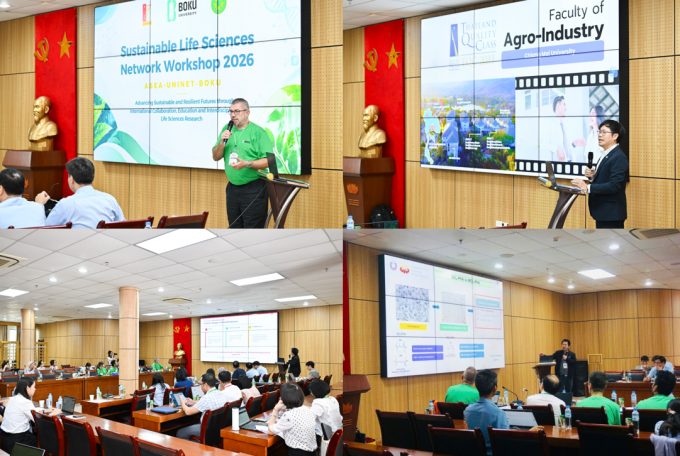
Participants engaged in discussions at the Workshop
Showcasing VNUA’s Research Capabilities and Applied Technology Models
As part of the workshop, participants visited VNUA to explore its facilities, laboratories, experimental models, and achievements in scientific research and technology application.
At the Institute of Biology and Agricultural Technology, VNUA, the delegation was introduced to biotechnology applications in the production of potatoes, Chinese yams and lilies, covering the process from tissue culture to field cultivation. At the Fruit and Vegetable Research Institute, VNUA, participants learned about orchid production models and discussed the application of technology in propagation, production and the development of high-value agricultural products.
The delegation also visited VNUA’s Center of Excellence and Innovation, where participants were introduced to laboratories and specialised research areas, including genetics, crop breeding, veterinary biotechnology, veterinary microbiology, infectious diseases, vaccine research, pharmacology, and drug development.
In particular, participants had the opportunity to explore the Environmental Analysis Laboratory, the Central Laboratory of the Faculty of Food Science and Technology, VNUA, and other research facilities supporting analytisis, testing, and research in food technology and biotechnology. The program also showcased VNUA’s research models and experimental facilities, enabling international partners to gain a better understanding of the university’s research capabilities, its capacity to undertake interdisciplinary projects, and its potential for scientific resource sharing.
The visits not only highlighted VNUA’s achievements and strengths but also enabled scientists to exchange views directly on research methodologies, technologies, equipment and opportunities for joint research. These interactions provided an important basis for identifying complementary expertise, making more effective use of available resources, and developing collaborative projects with strong practical applications.
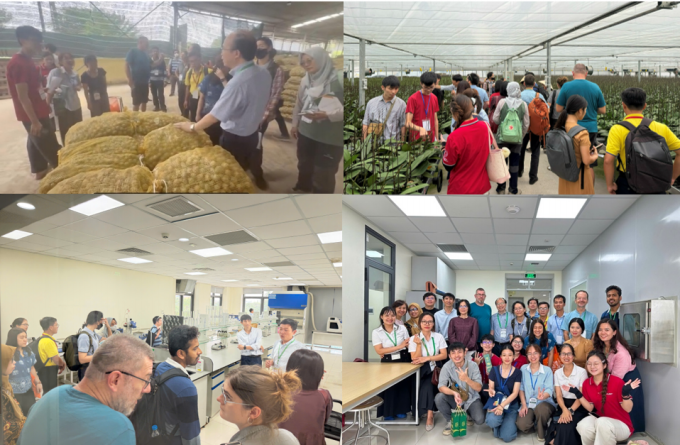
Visits to technology application models and laboratories at VNUA
ASEA-UNINET: A Bridge for International Academic Cooperation
The ASEA-UNINET network, connecting universities in Europe and Southeast Asia, was established in 1994 to strengthen cooperation between higher education institutions in the two regions through academic exchange, education, scientific research, and human resource development.
Through the network, member universities could expand their partnerships, promote exchanges of lecturers, students and doctoral candidates, undertake joint research activities, and access scholarship programs and funding opportunities for education and research.
For VNUA, ASEA-UNINET represented an important channel for international cooperation in improving the quality of education and scientific research. Over the years, many VNUA lecturers and students had had opportunities to participate in scholarship programs, study, exchange and conduct research at partner universities. VNUA researchers had also progressively expanded their professional collaborations and participated in or developed research projects associated with the network.
During this workshop, participants continued discussions on ASEA-UNINET programs, Ernst Mach Grants, KoEF programs and Erasmus+, as well as opportunities for study, academic exchange, and research collaboration. Information about international training programs and bachelor's and master's degree programs taught in English also helped broaden awareness of opportunities available to lecturers, students, and researchers.
Maintaining and expanding these connections was expected to create further opportunities for knowledge exchange, strengthen research capacity and broaden cooperation between VNUA and partner universities, particularly in interdisciplinary fields such as sustainable agriculture, biotechnology, environmental sciences, and food systems.
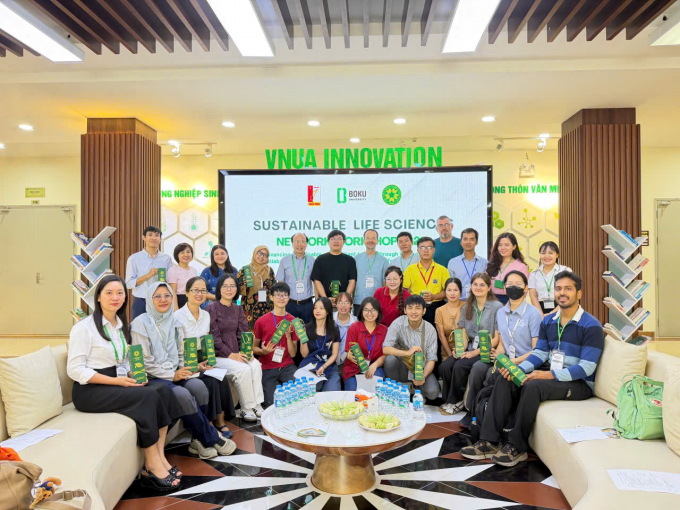
Visit to the Center of Excellence and Innovation, VNUA, and presentation of gifts in Celebration of the 70th Anniversary of VNUA
From Networking to Action: Towards Long-Term Collaborative Programs
One of the key objectives of the Sustainable Life Sciences Network Workshop 2026 was to translate academic exchanges into concrete directions for cooperation. Joint discussion sessions focused on identifying priority areas, defining next steps, clarifying the responsibilities of participating institutions, and establishing mechanisms to maintain connections beyond the workshop.
By bringing together expertise in agricultural sciences, soil science, environmental sciences, biotechnology, and food science, the workshop helped promote interdisciplinary approaches to addressing challenges related to sustainable development, climate change, and food security.
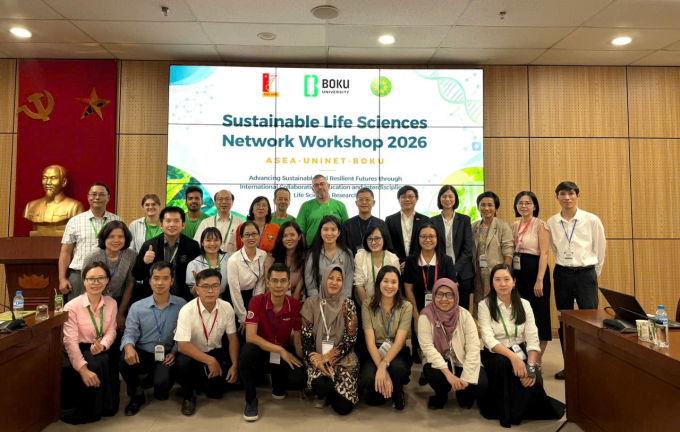
Participants at the Workshop
For VNUA, co-organising the workshop provided an opportunity to strengthen connections with international universities and research organisations, showcase its scientific and technological capabilities, and expand opportunities for cooperation in education, academic exchange, and joint research projects.
With its strategic orientation towards becoming a research-oriented, internationally integrated higher education institution closely connected with practical production, VNUA continued to promote international partnerships, leverage its academic expertise and scientific resources, and contribute to the development of modern, ecological, and sustainable agriculture.
The Sustainable Life Sciences Network Workshop 2026 was expected to foster meaningful connections among scientists, generate new collaborative initiatives, and contribute to building an effective and sustainable life sciences research network between European and Southeast Asian universities.
Faculty of Food Science and Technology