At the 21st Animal Science Congress of the Asian-Australasian Association of Animal Production Societies (AAAP) held in Hanoi, Prof. Dr. Nguyen Thi Lan, President of Vietnam National University of Agriculture (VNUA), stated that sustainable transformation of the livestock sector is impossible if small-scale livestock farmers are left behind.
According to Prof. Dr. Nguyen Thi Lan, livestock production plays an essential role in ensuring food security, food supply, rural livelihoods, economic development, and social welfare. However, the livestock sector today is facing intertwined challenges, including climate change and pressure on natural resources; environmental degradation; animal diseases and the risk of antimicrobial resistance; market fluctuations; as well as society's increasingly stringent demands for product quality, food safety, traceability, and especially high standards for animal welfare.
These challenges can be resolved neither through isolated scientific, technological, and technical advances, nor through the individual efforts of a single nation. Instead, they require a holistic, multidisciplinary approach, close cooperation, and joint action among countries across the region and around the world toward a sustainable, responsible, and climate-resilient livestock sector that ensures One Health.
    |
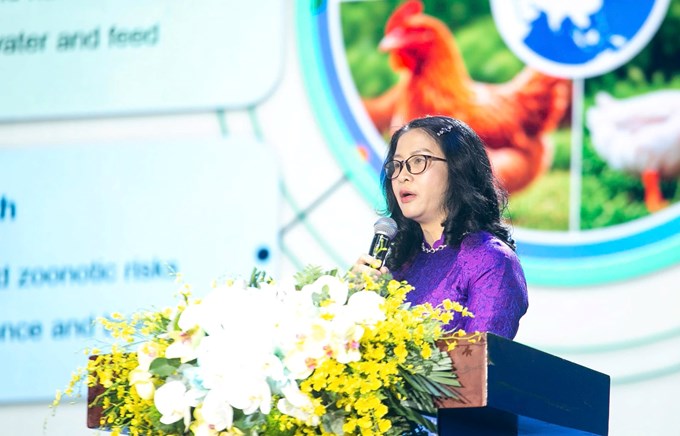 |
| Prof. Dr. Nguyen Thi Lan, VNUA’s President, states that sustainable transformation of the livestock sector is impossible if small-scale livestock farmers are left behind. |
"The question posed is how livestock production can simultaneously generate economic value, improve human quality of life, protect animal health and welfare, and preserve ecosystems for future generations. In my view, sustainable livestock transformation is first and foremost a shift in development mindset: from focusing on output to prioritizing efficiency and value; from isolated solutions to synchronized governance across the entire chain; from addressing consequences to proactively preventing risks; and from laboratory-confined innovation to innovation that delivers tangible benefits to livestock farmers, the community, and society," Prof. Dr. Nguyen Thi Lan emphasized.
She noted that the core spirit of sustainable livestock production can be expressed through three main objectives: for people, for animals, and for the environment. To realize these objectives, we must simultaneously strengthen four cornerstones as follows:
· The economic pillar: Generating value, improving productivity, efficiency, and competitiveness, and fostering profitable, sustainably developing livestock enterprises.
· The social pillar: Ensuring equity, inclusiveness, active participation, and equal access to knowledge, services, resources, and markets for all stakeholders across the livestock value chain.
· The environmental pillar: Promoting efficient resource utilisation, low emissions, climate change adaptability, and responsible environmental management.
· The animal pillar: Safeguarding animal health, animal welfare, and conserving biodiversity, and ensuring the responsible utilisation of livestock genetic resources.
Prof. Dr. Nguyen Thi Lan also outlined five solutions to build a sustainable livestock sector as follows:
First, take the science of breeding, nutrition, and indigenous resources as the foundation for enhancing growth quality. We need to conserve and sustainably utilize indigenous livestock breeds and genetic resources adapted to local conditions, while applying science-based breeding advances to improve productivity, quality, animal health, and resilience.
Parallel to this is developing sustainable feed sources and effectively utilizing agricultural by-products, biomass, local raw materials, and advanced nutritional solutions. Every step forward in breeding and feed needs to be evaluated not only by productivity, but also by resource efficiency and environmental impact.
Second, place animal health and welfare in an inseparable link with human and environmental health. The One Health approach requires close coordination among animal husbandry, veterinary medicine, public health, and environmental science. From biosecurity, disease surveillance, and prevention to responsible antibiotic use, antimicrobial resistance control, and food safety assurance, we need an interdisciplinary and proactive preventive approach.
"Animal welfare must also be considered throughout the entire process of breeding, rearing, transport, and slaughter, rather than at a single isolated stage" Prof. Dr. Nguyen Thi Lan emphasized.
Third, promote low-emission, climate-resilient, and circular livestock production. Waste management needs to shift from a treatment mindset to resource recovery, encompassing nutrient cycling, bioenergy generation, proper integration of crop and livestock farming, and the efficient utilisation of land, water, and other resources. Reducing greenhouse gas emissions, minimizing resource losses, and enhancing resilience to climate variability must become concrete targets in technology development, production models, and farm management.
Fourth, drive innovation and digital transformation across the entire value chain. Digital technologies, automation, data-driven management, smart livestock farming systems, and traceability are only truly meaningful when they help improve production decisions, reduce costs, control risks, and strengthen consumer trust. At the same time, it is necessary to build transparent and responsible value chains that connect producers with processing, distribution, and markets. In particular, technologies must be accessible and adopted in practice, rather than becoming an advantage reserved solely for large-resource enterprises.
Fifth, recognize people, institutions, and cooperation as decisive conditions for transformation. Small-scale livestock households, cooperatives, women, youth, and rural communities must have equitable opportunities to access knowledge, technology, finance, veterinary services, and markets. Support policies, investment mechanisms, and governance systems need to create incentives for enterprises, research institutions, universities, and livestock farmers to participate together. Regional and international cooperation needs to go beyond experience sharing toward joint research programs, data sharing, technology transfer, human resource training, and scaling up proven models.
"The five orientations above are closely interconnected. There can be no low-emission livestock production without technological innovation in feed, breeding, and waste management; there can be no safe products without disease control and traceability; and there can be no successful transformation if small-scale livestock farmers are left behind," Prof. Dr. Nguyen Thi Lan stated.