Prof. Dr. Nguyen Thi Lan proposes promoting the research and application of next-generation biotechnology in agriculture in response to business and market needs, while encouraging enterprises to take an active role in identifying research priorities, conducting trials, and refining products.
At the Northern regional conference on “Science, Technology, Innovation, and Digital Transformation Driving Growth in the Agriculture and Environment Sector” held on the morning of October 27, 2026, Prof. Dr. Nguyen Thi Lan, President of Vietnam National University of Agriculture (VNUA), delivered a key presentation entitled "Research and Application of Next-Generation Biotechnology in Agriculture: Removing Institutional Bottlenecks, Developing Spin-off Enterprises, and Commercializing Research Results from the Practical Experience of Vietnam National University of Agriculture."
According to Prof. Dr. Nguyen Thi Lan, next-generation biotechnology enables increasingly precise interventions in genes, cells, and biological systems. Prominent directions include gene editing, synthetic biology, protein technology, vaccines, and microbiomes, combined with big data and artificial intelligence.
"These technologies help create superior varieties and breeds, control diseases, use inputs efficiently, and convert by-products into valuable products; thereby enhancing self-reliance in varieties, breeds, and biological products, as well as the sector's competitiveness. To become a driver of growth, technology must be developed into products that are effective, safe, reasonably priced, and responsive to market needs," Prof. Dr. Nguyen Thi Lan emphasized.
    |
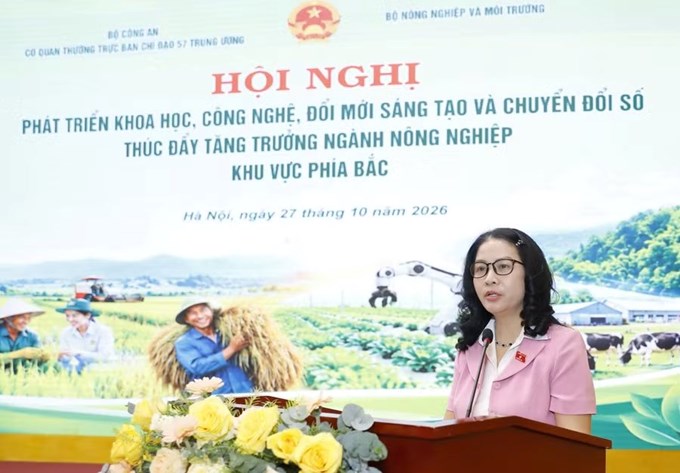 |
| Prof. Dr. Nguyen Thi Lan, VNUA’s President, puts forward four recommendations to promote the research and application of next-generation biotechnology into practical production. |
Drawing on international experience in developing high-value agricultural products through next-generation biotechnology, Prof. Dr. Nguyen Thi Lan cited Japan’s commercialisation of a gene-edited, GABA-enriched tomato in 2021 and collaboration between Wageningen University in the Netherlands and businesses to apply genomic technologies in plant breeding. She noted that Vietnam had made progress in next-generation biotechnology, including genomics, gene editing and advanced biological products, but their adoption remained uneven. Many research outcomes required further trials, safety assessments and cost reductions before wider application. Nevertheless, Vietnam had considerable potential to develop next-generation biotechnology.
To increase farmers' income, enhance business competitiveness, generate licensing revenues, strengthen self-reliance, and boost exports, Prof. Dr. Nguyen Thi Lan emphasized the need to identify the urgent problems to address and foster close linkage among the "three stakeholders" (Government – Academia – Industry) to ensure that products will be fully developed and brought to completion.
VNUA’s President stated that the university had achieved numerous accomplishments in applying biotechnology to research and breeding, such as applying molecular markers in breeding; researching Myostatin gene editing in H'Mong cattle toward increasing muscle mass; and developing vaccines, diagnostic biologicals, IgY antibodies, and bacteriophage combinations to control diseases and reduce the need for antibiotics. VNUA was also implementing intellectual property protection for its research results on the African Swine Fever vaccine. New technologies continued to be refined and evaluated for efficacy and safety.
During the 2016-2026 period, VNUA obtained 10 patents for inventions and utility solutions, 25 plant variety protection certificates,128 crop varieties approved for circulation, and 42 recognized technical advances.
Many results were transferred, such as stress-resistant Piétrain pigs, beef cattle crossbreeding using the BBB cattle breed, aeroponics for producing disease-free seed potatoes, EMINA preparations, VNUA-Biomix, as well as mushroom and microalgae technologies. The aeroponic technology were deployed in Indonesia, and the CT16 rice variety in Cuba.
However, Prof. Dr. Nguyen Thi Lan also pointed out several bottlenecks in applying biotechnology to practical production.
First, there is a lack of seamless coordination across the entire chain and a shortage of leading teams from research to market. Major tasks require a coordinating focal point, experts mastering core technologies, and enterprises participating right from the beginning. Meanwhile, there remains a shortage of personnel for technology selection consultancy, interdisciplinary research linkage, business matchmaking, and commercialization support; scientists still have to shoulder many tasks themselves, from conducting research to finding markets and negotiating contracts, leading to low commercialization efficiency.
Second, resources for bringing technology from the laboratory to production scale have not met requirements. A lack of funding for pilot production, standardization, and dossier completion leaves many promising results unqualified for enterprise adoption.
Third, obstacles remain when applying regulations on intellectual property and public assets to individual dossiers. Although there have been many regulations and guidelines on technology valuation for capital contribution into enterprises, scientists remain unfamiliar and not yet proficient in determining technology value; scientists are still confused about sharing and determining the contribution value of spin-off companies in the shared use of laboratories at universities and research institutes. Unified guidance with clear authority and responsibility is needed for institutions to implement these processes smoothly and in accordance with regulations.
From that reality, VNUA’s President put forward four recommendations as follows:
First, link research with practical needs and invest sustained investment through to commercialisation. Encourage enterprises to participate from the outset in defining research priorities, co-investing in development, refining products and develop the market. Focus on evaluating the capacity to master technology, product quality, and application efficiency; while supporting product refinement and technology transfer in phases in accordance with regulations. Additional funding should be invested in the post-research phase to further develop technologies and conduct market research for the research outputs.
Second, address barriers to the establishment and operation of spin-off enterprises. Call on relevant agencies to coordinate efforts in guiding and training scientists and research institutions on technology valuation, capital contribution, intellectual property commercialisation, and the use of laboratories and equipment.
Third, develop a highly skilled workforce to lead research and commercialization. Prof. Dr. Nguyen Thi Lan proposed that the Ministry of Agriculture and Environment and the Government should soon consider and approve the Project on Training High-Quality Human Resources for Breakthroughs in Science, Technology, and Innovation, prioritizing leading experts and team leaders mastering strategic and core technologies; as well as experts in science management, technology consultancy, policy formulation, and market development. Training needs to be tied to specific tasks and combined with international cooperation; coordination among regulatory agencies, institutes, universities, and enterprises needs to be strengthened; and there must be sufficiently strong and attractive policy mechanisms and sanctions to closely bind the three stakeholders (scientists, administrators, and enterprises).
Fourth, invest in infrastructure while ensuring its effective utilisation and shared access. She proposed investing in international-standard reference laboratories/key laboratories for food quality and safety, and disease diagnosis located at universities to enhance the capacity of the sector's laboratory system while supporting enterprises in meeting the requirements of export and import markets.