According to Prof. Dr. Nguyen Thi Lan, President of Vietnam National University of Agriculture (VNUA), technological advances can only generate widespread impact when supported by appropriate policies and translated into practice. Agricultural innovation should be evaluated not only in terms of its potential to increase productivity but also by its implementation costs, accessibility, and tangible benefits for farmers.
On October 8, 2026, VNUA hosted the AgriVision 2026 International Conference under the theme “Shaping the Future of Agriculture through Policy, Technology and Innovation.” The conference brought together policymakers, scientists, experts, representatives of universities and research institutes, international organizations, and businesses to exchange views on emerging trends shaping the future of agriculture.
Held as part of VNUA’s 70th anniversary celebrations (1956-2026), the conference was expected to provide a platform for connecting scientific research with policymaking and agricultural practice, while expanding international cooperation in strategic technologies, green transition, emissions reduction, and sustainable agricultural development.
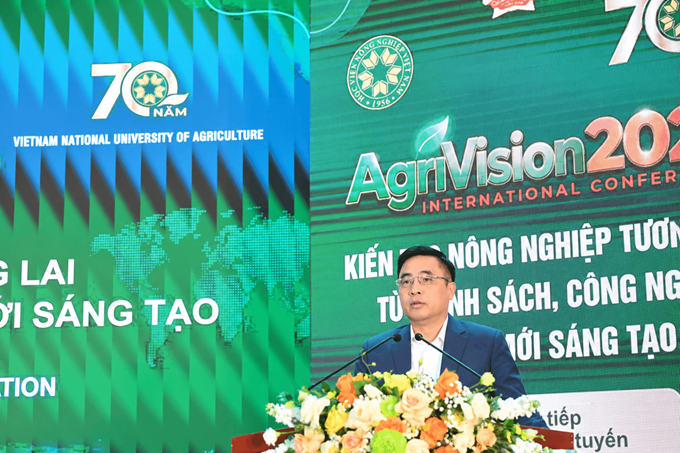
Deputy Minister of Agriculture and Environment Nguyen Quoc Tri delivers remarks at the conference. Photo: H.L.
In her opening remarks, Prof. Dr. Nguyen Thi Lan, VNUA’s President, emphasized that agriculture today had to simultaneously address multiple challenges, including ensuring food and nutrition security, increasing farmers’ incomes, adapting to climate change, conserving natural resources, and protecting public health.
These objectives were closely interconnected. A solution that increased productivity but caused long-term damage to soil, water, or human health could hardly be considered sustainable. Agricultural development strategies, therefore, had to take into account economic performance, social impacts, and environmental sustainability.
“We have chosen a theme that brings together policy, technology and innovation because we recognize that technological advances can only generate widespread impact when supported by appropriate policies and effective mechanisms for translating knowledge into practice.
Policymaking requires scientific evidence to identify the right priorities; technology needs adequate resources and a supportive environment for testing and application; and innovation serves as the bridge that brings knowledge into production and creates value for society.”
— Prof. Dr. Nguyen Thi Lan, Director of the Vietnam National University of Agriculture
From Research Findings to Tangible Benefits for Farmers
VNUA’s President noted that a considerable gap often remained between promising research findings and solutions that were widely adopted in practice.
Bridging this gap required more than demonstrating a technology’s technical advantages. It was also necessary to address implementation costs, safety, users’ capabilities, and access to markets.
“Besides asking, ‘What can this technology do?’, we need to ask, ‘Who can use it, at what cost, and what benefits will it deliver?’” Prof. Lan emphasized.
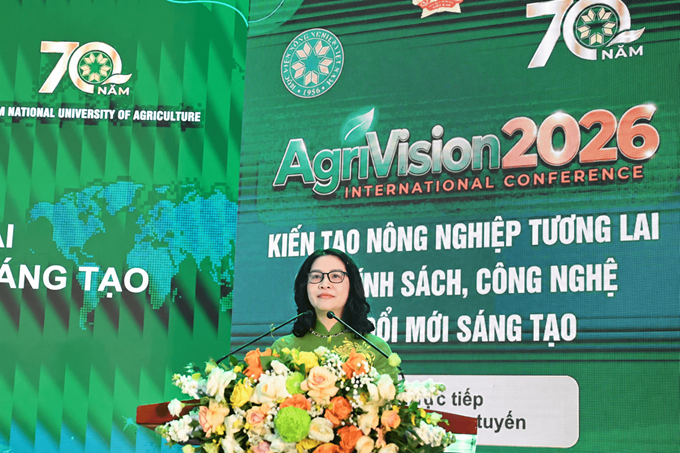
Prof. Dr. Nguyen Thi Lan, VNUA’s President, delivers the opening remarks. Photo: H.L.
According to Prof. Lan, farmers needed to be involved from the earliest stages of identifying and evaluating technological solutions. Their practical experience helped scientists identify the right problems to address, while improvements in production efficiency, income, and quality of life provided meaningful measures of the value of innovation.
From this perspective, she called on conference participants to focus on three key issues: identifying policy priorities that could remove barriers to research and technology adoption; exploring promising research directions with practical impact, supported by evidence of effectiveness, safety, and scalability; and developing collaborative initiatives that could be implemented following the conference.
Sharing this perspective, Deputy Minister of Agriculture and Environment Nguyen Quoc Tri observed that the traditional agricultural growth model, which relied heavily on land, labor, production inputs, and expanding output, was gradually reaching its limits. Meanwhile, climate change, natural disasters, diseases, resource degradation, and increasingly stringent international market requirements were placing additional pressure on agricultural production.
According to the Deputy Minister, continued agricultural growth could not simply come from producing more; it had to come from producing better and generating greater value. Every hectare of land had to deliver higher value; every unit of water, fertilizer, and plant protection product had to be used more efficiently; and farmers had to earn better incomes from their production activities.
The way forward, he argued, lied in increasing productivity through knowledge, improving quality through technology, reducing costs through innovation, and enhancing value through market development.
The Deputy Minister stressed that the critical question was not how many research projects, technologies, or inventions had been developed, but what problems they solved, who used them, how effective they were, and to what extent they could be scaled up. This was also essential to translating the objectives of Resolution No. 57-NQ/TW on breakthroughs in science and technology, innovation, and digital transformation into measurable outcomes.
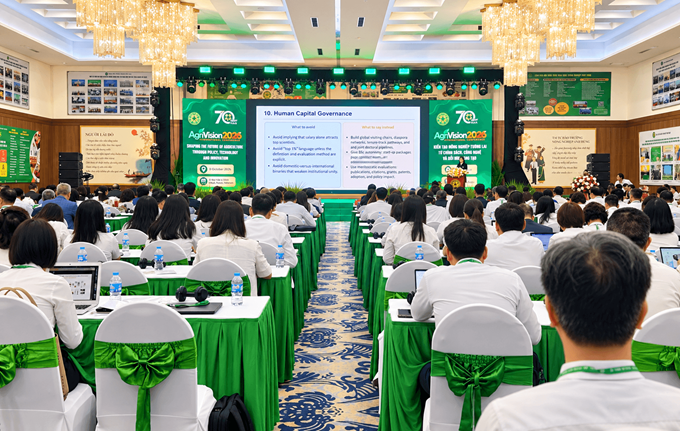
An overview of the conference. Photo: H.L.
Bringing Research to Market and Promoting Interdisciplinary Collaboration
One of the major bottlenecks identified by Deputy Minister Nguyen Quoc Tri was the persistent disconnect between scientific research and the needs of agricultural production. Some promising studies remained difficult to apply, while many specific needs of businesses and producers had yet to be matched with suitable technological solutions.
To address this challenge, he called for a decisive shift from research driven primarily by existing capabilities to research guided by practical needs and real-world demand; from isolated projects to large-scale, interdisciplinary programs; and from laboratory results to testing, refinement, commercialization, and wider adoption.
In this process, the Government had to establish enabling frameworks for experimentation and technology transfer; scientists had to solve technical problems; businesses had to invest, organize production, and bring products to market; and farmers had to be involved from the outset and directly benefit from the outcomes.
“Policies must pave the way; science must address real-world challenges; technology must be integrated into production; businesses must bring products to market; and farmers must remain at the center of the innovation process,” the Deputy Minister emphasized.
He noted that biotechnology, big data, artificial intelligence, automation, and remote sensing were creating opportunities to shift from experience-based to data-driven production, from reactive to predictive management, and from fragmented farming systems to transparent and efficient value chains.
However, technology could only deliver its full potential when it was suited to local production conditions, accessible to farmers, and supported by businesses capable of investing in and scaling up its application.
These issues were also central to AgriVision 2026. The plenary and thematic sessions focused on soil health and carbon, the transformation of agrifood systems, biotechnology and nanotechnology, disease control, and the One Health approach, which recognized the interconnected health of humans, animals, and the environment. The conference also explored policies, research, and innovation across crop production, animal husbandry, veterinary medicine, aquaculture, and food technology.
According to Prof. Lan, AgriVision 2026 should go beyond exchanging research findings and identifying technological trends. It should also help establish research priorities, formulate evidence-based recommendations, and develop concrete proposals for collaboration.
“The value of AgriVision 2026 will be measured by what we do together after the conference: the research we undertake, the solutions we test, and the benefits we deliver to producers,” VNUA’s President affirmed.
|
From the perspective of a higher education and research institution, Prof. Lan said that VNUA considers improving educational quality, strengthening research capacity, and translating scientific findings into practical applications to be key priorities in its next phase of development.
VNUA aims to work with its partners to develop interdisciplinary research groups, train young scientists, and establish pilot models that respond to the needs of businesses, local authorities, and agricultural producers. International cooperation is also viewed as a means of sharing knowledge, validating solutions under different conditions, and addressing challenges that extend beyond national borders.
|