Rather than waiting until students graduate to recruit them, businesses should engage from the outset of their education, working with universities to develop curricula, organize internships, and commission training tailored to production needs. This approach was essential to bringing education closer to labour-market demands and ensuring that scientific research translates into practical applications. These issues were once again brought into focus through concrete business needs at the Dialogue on Strategic Cooperation in Human Resources, Science and Technology, and Innovation, held on the afternoon of October 9, 2026, at Vietnam National University of Agriculture (VNUA).
Businesses as Partners from the Start of Training
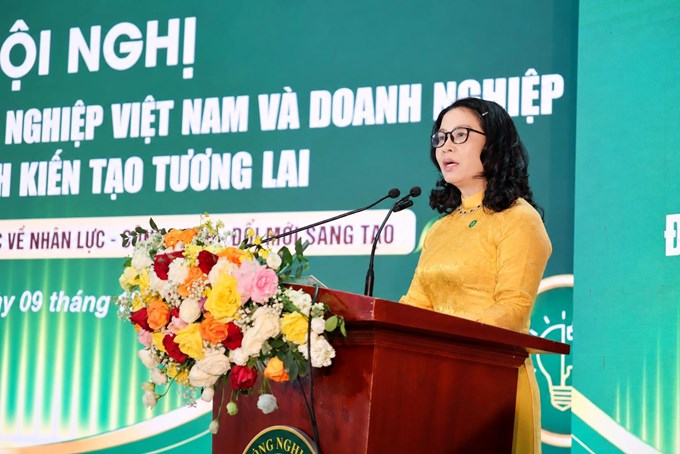
Prof. Nguyen Thi Lan, VNUA’s President, speaks at the conference. Photo: Mai Khoi.
Stronger partnerships between universities and businesses were essential to improving educational quality, making effective use of human resources, and meeting the demands of economic development. By involving businesses in the training process, universities gained valuable insights to keep their curricula up to date, while students became familiar with professional requirements at an earlier stage, helping bridge the gap between classroom learning and the realities of the workplace.
However, for this partnership to deliver meaningful results, cooperation had to go beyond hosting interns or recruiting graduates. Businesses needed to proactively share information on workforce requirements, professional standards, and technological developments. Universities could then use this information to update curricula, strengthen practical training, and prepare graduates with the skills and expertise employers need.
At the conference, Prof. Nguyen Thi Lan, Secretary of the Party Committee and VNUA’s President, emphasized that businesses needed to become strategic partners in education and training, research, innovation, and technology transfer. The two sides needed to work together to forecast workforce needs, develop training programmes, organize internships, and incorporate real-world industry challenges into teaching.
From the business perspective, Mr. Tran Manh Bao, Chairman of the Board of Directors and General Director of Thai Binh Seed Group, emphasized that linking education with workforce needs required concrete planning. Businesses had to clearly define their recruitment needs in terms of job positions, staffing numbers, and professional qualifications before commissioning training from universities.
For example, a company specializing in crop seeds might seek graduates in crop science, economics, management, and biotechnology. With clear information about employers’ workforce needs, universities could take a more proactive approach to curriculum development and training, while businesses could plan more effectively to recruit personnel aligned with their development strategies.
According to Mr. Tran Manh Bao, businesses needed to play a more active role in the training process by contributing to curriculum development and providing supervision and guidance for internships and graduation placements. By gaining exposure to production processes, specialized techniques, and real-world working environments, students could apply their knowledge and develop professional skills before graduation.
Beyond technical expertise, workforce quality was also reflected in employees’ sense of responsibility and work ethic. University–industry cooperation, therefore, needed to aim to develop students’ knowledge, practical skills, and professional conduct in tandem. This would help businesses reduce the time and resources needed for retraining while enabling graduates to better meet employers’ recruitment requirements.
From Production Needs to Technological Solutions

An overview of the strategic dialogue between VNUA and businesses. Photo by: Mai Khoi.
Beyond training and recruitment, university–industry collaboration also played an important role in scientific research, technology development, and product innovation. Practical production needed give rise to a range of challenges, from increasing productivity and reducing costs to improving processing methods. These challenges created opportunities for businesses to commission research, draw on the expertise of lecturers and scientists, and translate research findings into practical applications.
Speaking at the conference, Mr. Dinh Cao Khue, Chairman of the Board of Directors of Dong Giao Foodstuff Export Joint Stock Company (Doveco), said that approximately 70% of the company’s core team of around 100 personnel had received their education or undertaken study and research at VNUA. They worked across a broad range of fields, including crop science, animal science and veterinary medicine, economics, accounting, food chemistry, and automation.
These examples demonstrated that the role of educational institutions extended beyond supplying entry-level talent to developing a skilled workforce that supported production and business operations. Building on this foundation, stronger university-business cooperation could help align training more closely with workplace requirements and address emerging challenges as businesses grow and evolve.
Drawing on his company’s practical experience, Mr. Dinh Cao Khue recommended that VNUA strengthened training in automation and mechanization to improve productivity and product quality while reducing costs. The company also expressed interest in collaborating on research and rapid propagation techniques for high-value crops, including MD2 pineapple, banana varieties resistant to Fusarium wilt (Panama disease), vegetable soybeans (edamame), and spinach.
For pineapple production, Doveco had proposed research to develop and refine technical processes to increase yields and reduce production costs. This collaboration would combine the company’s practical experience with the research expertise of the university’s scientists.
In food processing, Doveco had worked with the Faculty of Food Technology and Science, VNUA, to develop a range of natural fruit juice products that had gained market acceptance. This achievement demonstrated how university research could be translated into products that met businesses’ practical needs.
According to Prof. Nguyen Thi Lan, the ultimate measure of applied research was its practical impact and the value it delivered to businesses, producers, and society. Cooperation, therefore, needed to be translated into concrete training, internship, recruitment, and research programmes, each with clearly defined objectives.
At the conference, VNUA also awarded scholarships to students and expressed its gratitude to the businesses, organizations, and individuals that had supported the university.
From education and research to technology transfer, stronger university–business partnerships aimed to align training with real-world needs, build a proactive pipeline of skilled talent, and bring scientific advances into agricultural production.