On the morning of March 24, 2026, Vietnam National University of Agriculture (VNUA) participated in the Regional Conference on “Sustainable Livestock Transformation for Food Systems in Asia and the Pacific”. The conference was co-organized by the Ministry of Agriculture and Environment of Vietnam, the International Livestock Research Institute (ILRI), the Food and Agriculture Organization (FAO), and the French agricultural research and international cooperation organization (CIRAD).
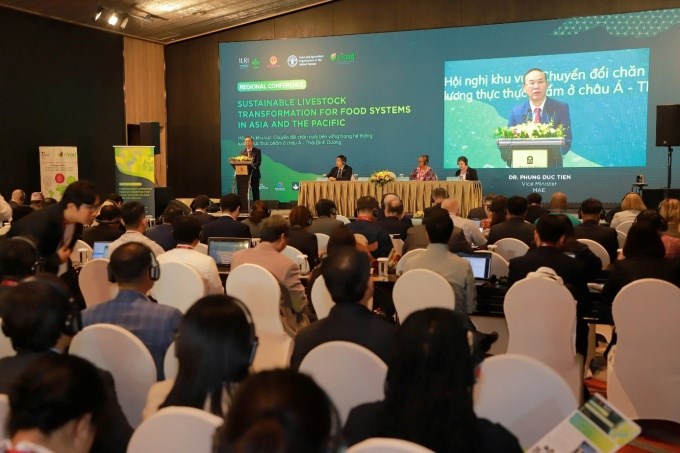
Overview of the Conference
The conference took place from March 24 to 26, 2026, with the participation of more than 150 delegates, including policymakers, managers, scientists, and researchers from various countries, as well as representatives from embassies, international organizations, research institutes, financial institutions, and the private sector. It served as a platform for discussing solutions to promote sustainable livestock development in the context of increasing demand for safe and nutritious animal-source foods, the need to expand production and improve farmers’ livelihoods, and growing challenges such as climate change, disease outbreaks, environmental degradation, and rising consumer expectations for safe and sustainable food.
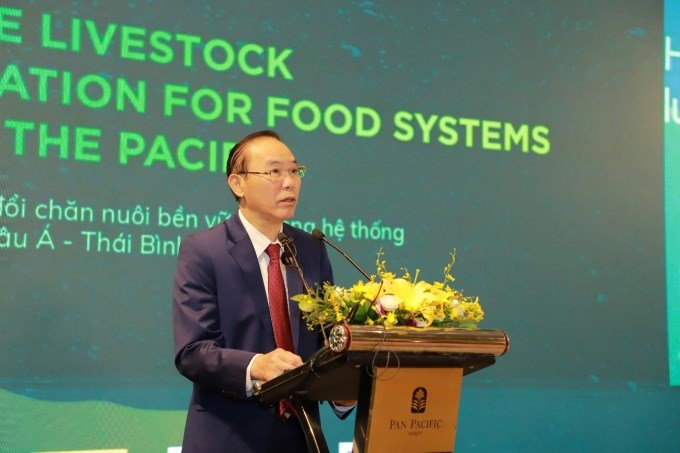
Deputy Minister of Agriculture and Environment Phung Duc Tien delivers the opening speech at the Conference.
In his opening remarks, Deputy Minister of Agriculture and Environment Phung Duc Tien emphasized the importance of collective action among countries. He stated, “Sustainable livestock transformation is not only a requirement for individual countries but also a shared global responsibility to ensure food and nutrition security and sustainable development. Therefore, increasingly deep and broad international cooperation among countries, international organizations, and key stakeholders is essential to promote innovation, facilitate technology transfer, and enhance the capacity of the livestock sector in the region.”
The conference held significant importance for Asia and the Pacific region which accounted for nearly 60% of the world’s population and approximately 44% of the global livestock population. Demand for animal-source foods in the region continued to rise rapidly due to population growth, urbanization, and increasing incomes. At the same time, livestock systems both contributed to and were affected by climate change, environmental degradation, zoonotic and transboundary animal diseases, as well as growing expectations for safe and sustainably produced food.
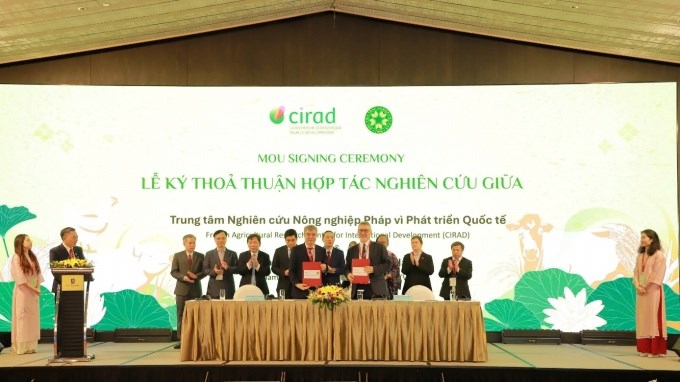
VNUA signs a memorandum of understanding with the French agricultural research and international cooperation organization (CIRAD).
As a key national university and a leading center for high-quality human resource training, scientific research, technology development, and knowledge transfer in agriculture and rural development, VNUA had achieved remarkable results in research, models, and solutions for livestock development in a green and circular direction. These efforts emphasized the application of high technology, biosafety assurance, and adaptation to climate change. Such achievements clearly demonstrate the university’s role in closely integrating high-quality human resource training with scientific research and the transfer of science and technology into practical production.
Within the framework of the conference, VNUA signed memoranda of understanding with the CIRAD and ILRI, opening up numerous opportunities for cooperation in sustainable livestock development, circular agriculture, and climate change adaptation.
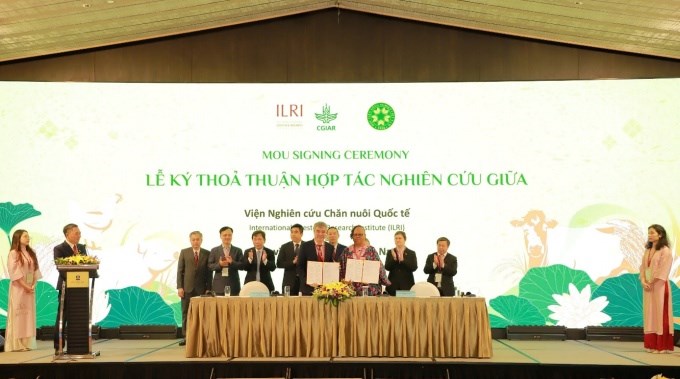
VNUA signs a memorandum of understanding with the International Livestock Research Institute (ILRI).
At the conclusion of the conference, participants would develop recommendations for a regional roadmap toward the sustainable transformation of the livestock sector, including priorities in research, policy, and investment. These recommendations were expected to guide future regional cooperation activities while contributing to global efforts to transform livestock systems within the broader transition of food systems.