Infection and Propagation of Cryptocaryon irritans on Golden Pompano (Trachinotus spp.) in Vietnam
Updated on 14:33, Thursday, 05/02/2026 (GMT+7)
Cryptocaryon irritans is an ectoparasitic protozoan responsible for white spot disease, posing a significant threat to mariculture systems in Vietnam. A research team from the Faculty of Fisheries, Vietnam National University of Agriculture carried out a study to isolate and propagate C. irritans, and to establish an experimental infection model in Trachinotus spp. (5-7cm in length) under laboratory conditions.
Cryptocaryon irritans is an ectoparasitic protozoan responsible for white spot disease, posing a significant threat to mariculture systems in Vietnam. A research team from the Faculty of Fisheries, Vietnam National University of Agriculture carried out a study to isolate and propagate C. irritans, and to establish an experimental infection model in Trachinotus spp. (5-7cm in length) under laboratory conditions.
    |
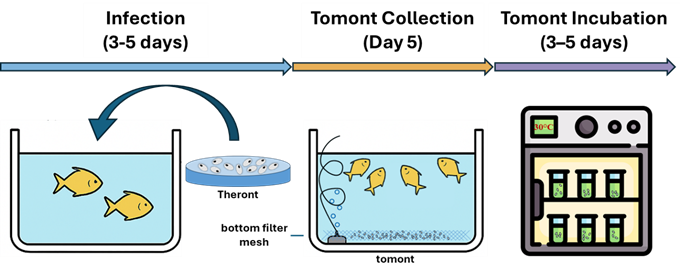 |
| Figure 2. Schematic of C. irritans isolation, propagation, and infection protocol |
Between February and June 2025, a total of 106 fish samples were sourced from aquaculture operations in Quang Ninh and Khanh Hoa, revealing an average C. irritans infection rate of 59.43%, with the highest prevalence observed during March and April. The method for infection and propagation of C. irritans on golden pompano (Trachinotus spp.) juveniles (5-7cm in length) was successfully established, demonstrating the ability to maintain a viable parasite line under laboratory conditions in Vietnam. From 106 fish samples collected from hatcheries and marine farms in Quang Ninh and Khanh Hoa provinces between February and June 2025, 63 samples (59.43%) were positive for C. irritans, with the highest prevalence recorded during the early stocking months (March-April).
Infected fish exhibited clinical signs including skin darkening, mucus loss, white spots on the skin and gills, fin erosion, ulcerations, and tissue damage. The parasite was successfully cultured at the trophont stage and was propagated to the tomont and theront stages at 28-30°C, achieving a conversion efficiency of 61.7% after 48 hours and yielding an average of 150-300 theronts per tomont. These theronts were introduced to Trachinotus spp. at a density of 5,000 theronts per 250L tank (50 fish) at a temperature of 28°C. The infection progressed rapidly, with trophonts observed within 2-3 days and cumulative mortality reaching 100% by day seven.
|
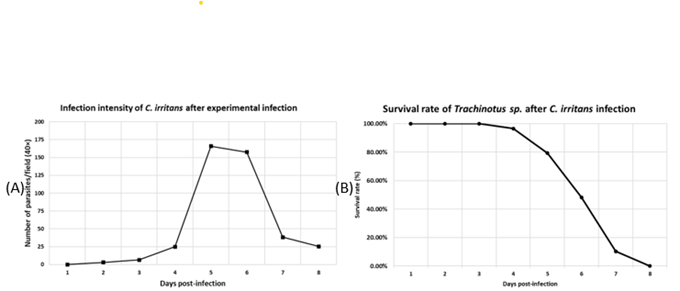 |
| Figure 6. The experimental infection of C. irritans to Trachinotus spp. (A) Infection intensity; (B) Survival rate of Trachinotus spp. after infection |
The established infection model offers a robust platform for further research in epidemiology, immunology, and therapeutic interventions against C. irritans.
For the full paper, please visit https://doi.org/10.31817/vjas.2025.8.4.04.
Vietnam Journal of Agricultural Sciences