1. The Concept of Kokumi
For decades, the culinary and food science worlds recognized only five basic tastes: sweet, sour, salty, bitter, and umami. However, researchers have identified a sensory characteristic that makes a dish more "complete" and "delicious" without belonging to any of the aforementioned tastes. This is Kokumi (コク味).
The term "Kokumi" originates from Japanese, combining koku (richness, depth) and mi (taste). Unlike basic tastes, kokumi substances are virtually tasteless when dissolved in pure water at low concentrations. Instead, they act as flavor modulators that enhance mouthfulness (thickness), continuity (lingering aftertaste), and harmony (the seamless integration of flavors) (Ueda et al., 1990).
2. History and Development
The concept of "Koku" has long existed in Japanese culinary culture to describe slow-cooked stews or fermented foods. However, its scientific systematization only began in the late 20th century.
1980s: Scientists at the Ajinomoto Group (Japan) began researching garlic extracts. They discovered that certain tasteless compounds could significantly enhance umami and saltiness.
1990: Ueda's research group first proposed the term "Kokumi" in modern food science, identifying compounds such as Glutathione (a tripeptide) as primary agents.
2010: A major breakthrough occurred when Ohsu et al. demonstrated that kokumi substances interact with Calcium-sensing receptors (CaSR) on the human tongue. This discovery officially transitioned Kokumi from an abstract concept to a well-defined physiological subject.
3. Physiological and Biochemical Basis
The mechanism of Kokumi is closely linked to G Protein-Coupled Receptors (GPCRs), specifically the extracellular Calcium-sensing receptor (CaSR).
3.1. Interaction with CaSR Receptors
While CaSR is primarily known for regulating blood calcium levels, it is also expressed in taste cells. Kokumi-active substances (such as glutathione and γ-glutamyl peptides) act as Positive Allosteric Modulators (PAMs) for CaSR.
When kokumi molecules bind to the CaSR, they induce a conformational change in the receptor, making it more sensitive to other taste stimuli (particularly umami, sweet, and salty) occurring simultaneously. This explains why kokumi has no intrinsic taste but can cause a flavor "explosion."
3.2. Chemical Nature:
Kokumi substances are mainly sulfur-containing peptides and γ-glutamyl peptides. The most prominent structures include:
Ø Glutathione (GSH): γ-L-glutamyl-L-cysteinyl-glycine.
Ø γ-Glutamyl-valyl-glycine (γ-Glu-Val-Gly): A potent kokumi peptide, approximately 250 times more effective than glutathione.
4. Natural Sources and Concentration: Kokumi exists naturally in various foods, typically enhanced through thermal processing or fermentation.
Table 1: Concentration of Kokumi Compounds in Natural Foods
|
Food Type
|
Primary Kokumi Compound
|
Estimated Content (mg/100g)
|
|
Garlic (Fresh)
|
S-Allyl-L-cysteine sulfoxide
|
500 - 1200
|
|
Onion
|
γ-Glu-S-alk(en)yl-L-cys
|
150 - 200
|
|
Scallops
|
Glutathione (GSH)
|
50 - 100
|
|
Parmesan Cheese
|
γ-Glu-Glu / γ-Glu-Gly
|
20 - 50
|
|
Traditional Fish Sauce
|
γ-glutamyl peptide mix
|
100 - 300
|
|
Shiitake Mushroom
|
Lentinic acid
|
40 - 80
|
Data adapted from Kuroda & Oyama (2014) and Rhyu & Kim (2011).
5. Applications in the Food Industry
Ø Salt and Sugar Reduction: Kokumi enhances the perception of saltiness and sweetness, allowing manufacturers to reduce Sodium and sugar content while maintaining palatability.
Ø Improving Low-Fat Foods: It provides the "creamy" and "rich" mouthfeel in diet products without adding actual fats.
Ø Enhancing Processed Foods: Restores freshness and extends the aftertaste of canned or frozen foods that lose flavor during high-heat processing.
6. Future Research and Application Directions
Ø Plant-based Meat Alternatives: Utilizing kokumi to replicate the "meaty" depth and lingering savory notes often missing in vegetable proteins.
Ø Nutrition for the Elderly: Applying kokumi to stimulate the appetite of seniors, whose taste sensitivity naturally declines with age.
Ø Biotechnology and Precision Fermentation: Researching the use of genetically engineered yeast and bacteria to produce pure kokumi peptides at an industrial scale.
    |
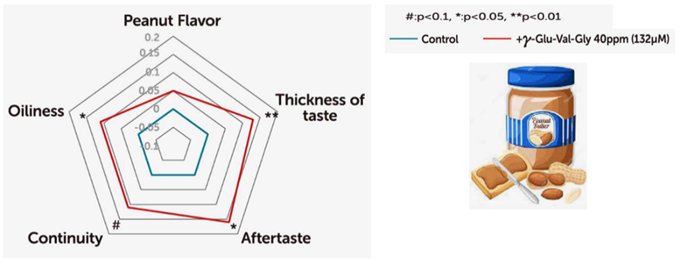 |
| Picture 1. The effect of γ-Glu-Val-Gly on low-fat peanut butter |
References
Ajinomoto Group. (2021). The Science of Kokumi: Beyond Umami.https://www.ajinomoto.com.vn/vi/kokumi-giup-nau-nhieu-mon-an-ngon-va-tot-cho-suc-khoe#
Kuroda, M., & Oyama, S. (2014). Analysis of kokumi-substances in food by LC-MS/MS. Journal of Agricultural and Food Chemistry, 62(21), 4432-4438.
Maruyama, Y., Yasuda, R., Kuroda, M., & Eto, Y. (2012). Kokumi substances, enhancers of basic tastes, induce responses in calcium-sensing receptor. PLoS ONE, 7(4), e34489.
Ohsu, T., Amino, Y., Nagasaki, H., Gladman, T., Uzawa, S., Hara, Y., & Eto, Y. (2010). Involvement of the calcium-sensing receptor in human taste perception. Journal of Biological Chemistry, 285(13), 1016-1022.
Rhyu, M. R., & Kim, E. Y. (2011). Umami and kokumi: Essential elements for savory flavor. Food Science and Biotechnology, 20(5), 1177-1185.
Ueda, Y., Sakane, R., Miyajima, K. I., & Miyadate, A. (1990). Compositional changes in sulfur-containing compounds in garlic extract during storage and their effects on flavor. Agricultural and Biological Chemistry, 54(1), 163-169.
Winkel, C., de Klerk, A., Visser, J., de Rijke, E., Bakker, J., & Koenig, T. (2008). Kokumi-enhancing molecules: Next-generation flavour modulators. Food Technology, 62(11), 30-35.
Faculty of Food Science and Technology