On December 1, 2025, a delegation from Raiganj University and Biswa Bangla Bisabidyalay, India, visited the Faculty of Accounting and Business Management, Vietnam National University of Agriculture (VNUA). The aim of the visit was to discuss potential collaboration in training and scientific research between Faculty of Accounting and Business Management, VNUA, and the Indian universities. The delegation included Assoc. Prof. Dr. Tapas Pal, Faculty of Geography, Raiganj University, leader of the delegation; Dr. Prabhakar Thapa, Faculty of Geography and Geoinformatics, Biswa Bangla Bisabidyalay; and Dr. Chinmoy Das, Center for Agricultural Research, Raiganj University. Welcoming the delegation were Assoc. Prof. Dr. Do Quang Giam, Dean of the Faculty of Accounting and Business Management, VNUA; Assoc. Prof. Dr. Nguyen Anh Tru, Vice Dean; Dr. Phi Thi Diem Hong, Vice Dean; and MSc. Tran Mai Loan, International Cooperation Assistant.
The working program consisted of the following two main parts: (i) Discussion on cooperation in training and scientific research; and (ii) Presentation of research findings at a seminar. In the first part, both sides discussed collaboration in: (i) Lecturer and student exchange programs; (ii) Joint implementation of scientific research projects on topics of mutual interest; and (iii) Co-organizing seminars/workshops to share research outcomes.
Following this, the Indian professors delivered two seminar presentations entitled “Developing organic agriculture for indigenous rice varieties in Uttar Dinajpur District, West Bengal, India: Sustainable management of health, environment, and business” and “Geography, production, heritage, and global importance of Darjeeling Tea.”
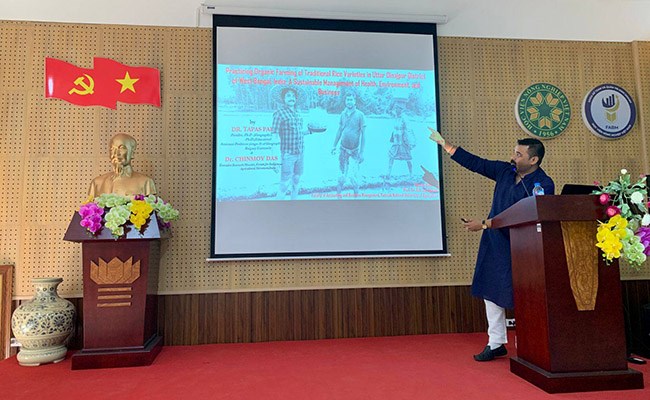
Assoc. Prof. Dr. Tapas Pal delivers his presentation at the seminar
The seminar attracted the participation of lecturers and students of Faculty of the Faculty of Accounting and Business Management. The first presentation showed that after comparing 10 indigenous rice varieties with 10 newly developed ones, indigenous varieties demonstrated superior quality, better adaptability to harsh weather conditions, taller plant height, and lower maintenance requirements. The second presentation highlighted that Darjeeling tea had gained global recognition since the 1980s in West Bengal, associated with the “3Ts” (Tea, Timber & Tourism). It also emphasized the need to re-evaluate tea gardens to enhance training and skills among tea growers, especially younger workers. After the presentations, the professors received many questions from participants during the discussion session.
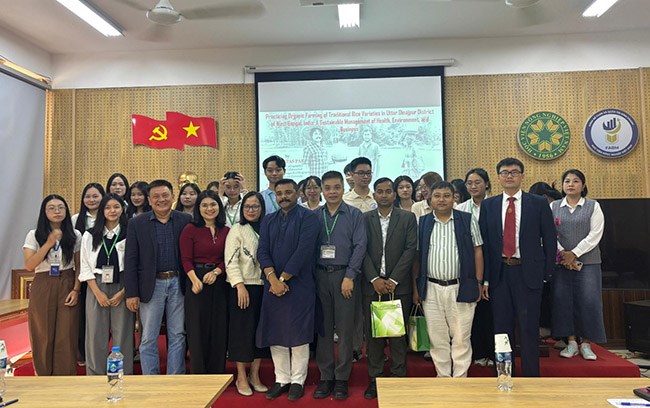
Delegates attending the seminar take a photo.
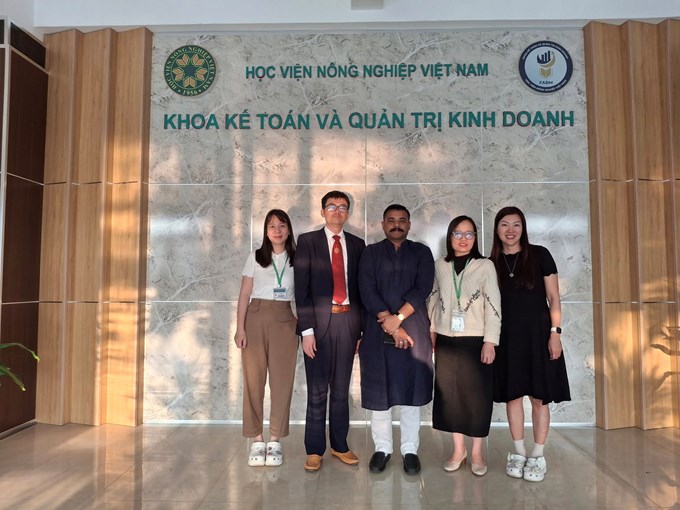
The visiting delegation takes a photo at the Faculty of Accounting and Business Management, VNUA.
After more than two hours of productive discussions, the working session between the Indian universities and the Faculty of Accounting and Business Management, VNUA, concluded successfully. The program provided lecturers and students with new knowledge about organic rice and tea cultivation while opening up opportunities for future cooperation in training and scientific research. It was expected that more collaborative programs in training and science–technology would continue to develop between the Faculty of Accounting and Business Management, VNUA, and Indian universities in the coming years.