As part of the working visit of Assoc. Prof. Dr. Clemens Karl Peterbauer from BOKU University, Austria, to the Microbiology and Food Safety Research Group in connection with the ASEA 19-2024 project entitled “Biodegradation of biogenic amines by enzymes from halotolerant bacterial sources”, funded by the Austrian Agency for Education and Internationalisation (OeAD) in cooperation with the Federal Ministry of Education of Austria, a scientific seminar was held on the afternoon of April 10, 2026, at the Faculty of Food Science and Technology, Vietnam National University of Agriculture (VNUA). On this occasion, Assoc. Prof. Dr. Clemens Karl Peterbauer delivered a presentation entitled “Cell factories for secretory enzyme production.”
The seminar was attended by Assoc. Prof. Dr. Nguyen Hoang Anh, Dean of the Faculty of Food Science and Technology; Assoc. Prof. Dr. Nguyen Thi Thanh Thuy, Head of the Microbiology and Food Safety Research Group; together with lecturers, researchers, and students from the Faculty of Food Science and Technology and the Faculty of Biotechnology, VNUA.
During the seminar, Assoc. Prof. Dr. Clemens Karl Peterbauer gave an in-depth presentation on cell factory technology for extracellular enzyme production, an important research area with broad applications in many different fields.
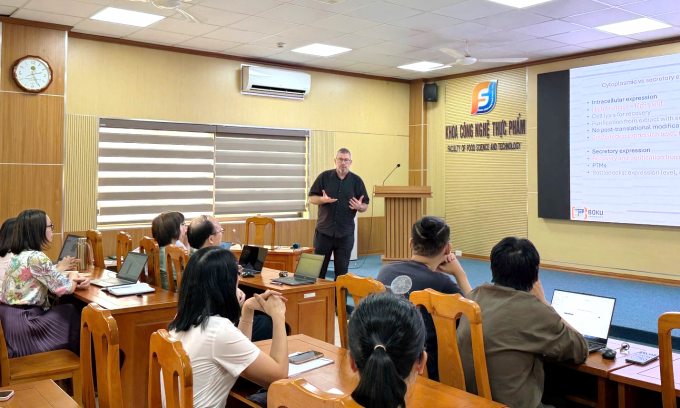
Cell factories are genetically engineered biological systems in which bacteria, yeasts, or animal cells are modified to produce enzymes on an industrial scale. Secretory enzyme production, also referred to as extracellular enzyme production, is considered an advantageous strategy because it allows enzymes to be secreted directly into the culture medium rather than accumulated inside the cells. This approach helps significantly reduce downstream recovery and purification costs, minimize intracellular toxicity, and protect enzymes from degradation by intracellular proteases of the host cells.
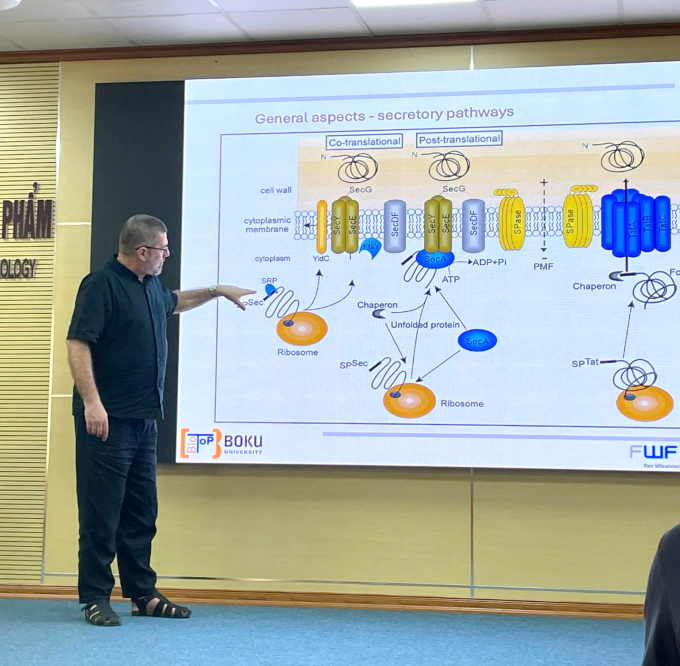
Several cell factory systems are currently used for extracellular enzyme production, including bacterial hosts such as Bacillus subtilis, Escherichia coli, Streptomyces lividans, and Amycolatopsis species; the yeast Saccharomyces cerevisiae; and filamentous fungi such as Aspergillus, Rhizopus, Mucor, Penicillium, Trichoderma reesei, and Neurospora crassa. In eukaryotic organisms, enzymes pass through the endoplasmic reticulum and Golgi apparatus, where they are properly folded and may undergo post-translational modifications such as glycosylation—processes that bacteria are generally unable to perform. As a result, complex enzymes requiring accurate three-dimensional structures or high biological activity can be produced with quality closer to their natural forms.
One of the major advantages of extracellular enzyme production lies in the simpler recovery and purification process, higher productivity, and greater stability of the enzymes in the extracellular environment. However, several challenges still remain, including low secretion efficiency, degradation by extracellular proteases, and protein misfolding. To overcome these limitations, researchers are focusing on strategies such as signal peptide optimization, co-expression approaches, and host genome engineering. This technology plays an important role in the industrial production of enzymes used in detergents, food processing, pharmaceuticals, and biofuels, thereby contributing to the development of a green and sustainable bioeconomy.
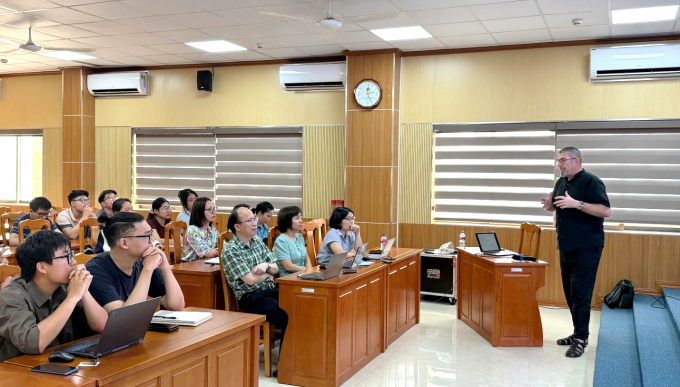
The seminar offered valuable insights into current advances in molecular biotechnology and their potential applications in food technology and related fields. It also created opportunities for academic exchange and opened up promising prospects for future international research collaboration.
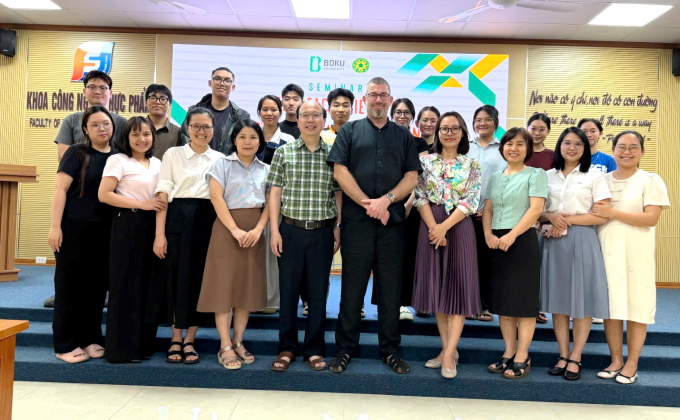
Microbiology and Food Safety Research Group